


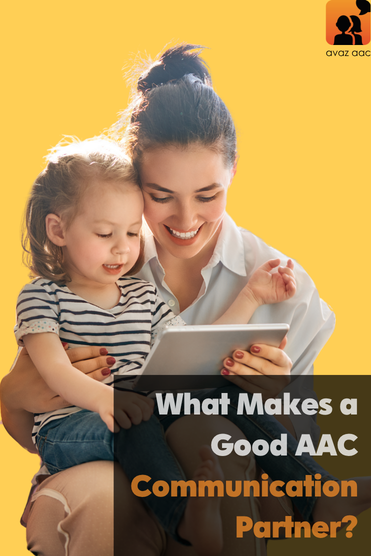
Successful communication is a shared responsibility, and when the exchange includes an AAC system, supportive communication partners make a world of difference. Communication partners must be aware of how their behaviour and expectations impact the outcomes of the communication exchange. An effective Communication Partner sets the stage for communication by utilising every interaction as an opportunity to grow language and communication.
Regardless of the AAC system being used, the principles of effective partnership remain the same. Let’s look at some mindset shifts and strategies that pave the way for a supportive environment.
Mindset matters
Presuming Competence: We will believe that everyone has the potential to communicate and will do so with the right tools and training. Providing a Robust AAC system with core words, fringe words, ready-made phrases, alphabet, and grammar markers. Providing authentic and motivating reasons to communicate makes learning language with AAC worthwhile for your learners. Having AAC available always.
Skills that we need to develop to become better communication partners
Active Listening involves giving complete attention and showing genuine interest in the person’s message. As a communication partner, your nonverbal cues tell a lot about your engagement in the exchange. Show your attention with appropriate eye contact and acknowledge your understanding with nodding. Being impatient by looking away or looking at your watch may only create anxiety for the individual and hamper the communication process, especially when the user is an emergent communicator. It is helpful when you stop whatever you are doing and give your full attention to the interaction when an attempt to communicate is made- this behaviour shows the learner that what they have to say is important.
Resist the urge to complete and predict what they want to say. Even though it may come from a good place of trying to help them complete their message, it may seem disempowering to the AAC user. We have to remember that nobody is a mind reader and cannot predict their communication intent every single time.
Consider the physical environment- make sure the device is positioned at the correct angle to avoid glare. Look for options to minimise the background noise, and try to stay at eye level when interacting with the user to facilitate a pleasurable interaction.
Supporting autonomy and independence
Recognise that users are experts in communicating their own needs and preferences. Avoid touching someone’s communication device or physically prompting them in an attempt to make communication easier for them, as this may feel invasive. Model from a separate device or low-tech board where appropriate. Use minimal prompting where necessary while using lots of expectant pauses. Provide choices whenever possible and honour them always.
Respond to multimodal communication be it high tech,low tech or gestures..We validate their communication attempts by responding to different forms of communication. Respond to the message that they are conveying through different means like gestures, facial expressions, and AAC- not just responding to their AAC. We are all multimodal communicators, and we use a variety of means to communicate our thoughts, like gestures, speech, texting, pointing, etc. Same goes for the AAC user- they may use the communication method(s) that are most convenient to them at the moment. For example, they may select some words on AAC and use gestures to complete the phrase, e.g., DONT WANT in AAC, and Fish is through gestures to say, ” don’t want fish. It is natural and to be accepted and responded to. Never ask them to ‘Say it on the device’ again.
Support them to self-advocate for their communication needs, like asking for more wait time or asking us to repeat the question.
Focus on the person and interaction and not the device- talking to them directly and involving them in group conversations rather than the caregivers. Pay attention to them rather than looking at their AAC when they are formulating the message. Use natural conversation patterns when conversing with them rather than using a loud voice. Be age-respectful and avoid baby talk if it is not age-appropriate. Always acknowledge their communication attempts
Ask clarifying questions when needed; help them understand that this is common in a conversation, as we tend to misunderstand others, and this is not a failure. This only shows that you are interested in the conversation. Using phrases like tell me more or summarising what has been spoken about till then can be helpful in moving the conversation forward.
Extend their communication- using phrases like “tell me more”, “what happened?”,” next “will help them elaborate on their message and give them the confidence that you want to hear what they have to say.
Balance the communication exchange by sharing your thoughts and perspectives as well. Getting comfortable with the silences when they are formulating the messages is helpful. However, avoid dominating the conversation.
Look for communication opportunities in everyday exchanges and routines and support them in being active communicators throughout the day- ask for their choices when deciding the menu, share something interesting and ask for their opinion, play language-rich games -all of this helps them in experiencing the joy of communication.
Helpful strategies
Modelling is one key strategy that we, as Communication Partners, can use when introducing AAC to the user; as we speak to the user, we point to key words in the AAC system. This helps the user to see how it looks like to use AAC in real conversations, what the words mean, where to use them and where to find them and over time they will start using it. AAC system becomes a natural part of their conversations. We have to model regularly and consistently across different situations for different reasons with different people.
Please remember that it is perfectly fine if the user is not even looking at the AAC system- Model anyway because many models of the same words are needed before they can use the word themselves. There is no need for them to respond to your models or even imitate them.
Comments and statements instead of questions. Asking a lot of questions puts the other person in a responder’s role. They may not initiate conversation and may feel that they are being tested, and the joy of conversation may not be there. Use a lot of comments, description and narration when modelling on the AAC so that they see AAC being modelled for real conversations. Even when using questions, try asking open-ended questions that might not limit them to responding to either the right or wrong answer.
Expectant Pause. AAC users may need time to start their body moving to communicate. Give them time to process what is required of them, formulate the answer and compose their message in the AAC. Pause for them to take their turn and respond. Avoid prompting them unnecessarily. When communicating with them, use expectant pauses (using engaged facial expressions while signalling to the AAC user it is now their turn to communicate), indicating that what they communicate matters to you.
Providing prompts. Prompting the AAC user so that it becomes easier for them to use the AAC system is something everybody around them does all the time. We should be aware of how much prompting to give and when to give them. We should be mindful of following the prompting hierarchy, and the goal is to make them independent communicators. Care should be taken not to use physical prompting, as that does not help with learning and is the most difficult to wean off as well. When there is no response from the user after pause time and prompting, we could model instead. Communicating with AAC may take longer as the user processes information and navigates the system to make their selection. Use expectant pauses rather than jumping to prompt them.
Responding consistently to what is said on the AAC system is really important- it encourages interactions with the user and gives us more opportunities to model and use language
We should always acknowledge a communication attempt.We should do this even if the selection made is not available right away
Even if we don’t understand the relevance of the word selected by them on the AAC, we can attribute meaning depending on the context rather than simply dismissing it off saying that it is wrong. We can expand on what the user says by either adding a word(expansion)or telling it again in a different way (recast)
Respond appropriately- when they are communicating an exciting message, show enthusiasm; when they express discomfort, comfort them. Model the different reasons for which we communicate every day and respond appropriately when they do the same
Being an effective communication partner is an ongoing process that changes with the skills of the user -so be flexible and understand that what suits one person may not work for the other. It is also helpful to ask the AAC users the kind of support they need. When you use strategies when modelling and interacting with your user we are showing other communication partners how best to support the user and are building an inclusive society in the process.
References
https://www.assistiveware.com/learn-aac/build-communication-partner-skills
https://quicktalkerfreestyle.com/blog/aac-communication-partner/
https://atnetwork.ttaconline.org/aac-communication-partner-training
WRITTEN BY
Niveditha Ryali
Speech – Language – Swallowing Therapist
I have years of experience that comes from working in NHS(UK), special schools, hospitals and private practice. My passions are working on improving Speech, Language and Swallowing skills in children and adults. I also strive to facilitate early communication in children with complex communication needs, thereby improving parent-child bonding.

Besides Avaz AAC, we provide a whole host of exciting products & services. Use the buttons below to explore Avaz!